
A restaurant or warung in Bali can have the best food on the street and still lose customers to a mediocre competitor who shows up first in Google search results. Digital visibility — specifically Google Maps and local search optimization — has become a meaningful competitive differentiator for Bali’s F&B sector.
This guide covers the specific tactics that help Bali restaurants and warungs get more guests from Google.
The Search Journey of a Bali Dining Customer
Understanding how customers find restaurants in Bali is the starting point for any optimization effort.
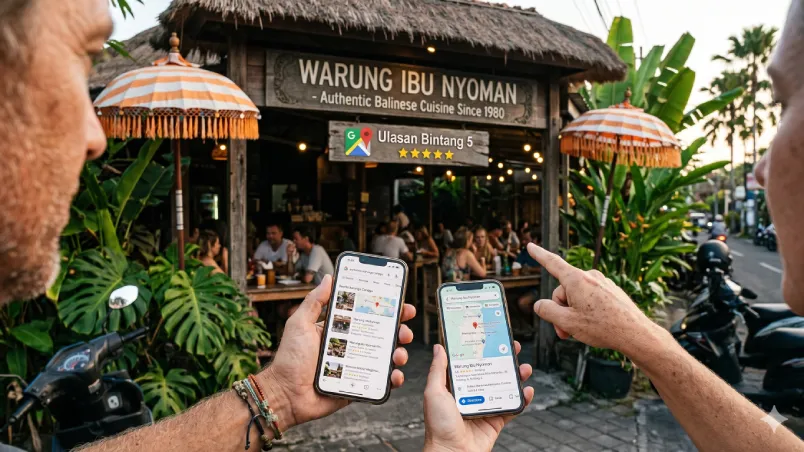
In-destination searches (highest volume). The largest segment: guests who are already in Bali and searching for a meal right now. “Restaurants near me,” “best nasi goreng Canggu,” “breakfast cafe Seminyak open now.” These searches happen on mobile, often while standing on the street. Google Maps results dominate — the local map pack shows three businesses with ratings, open/closed status, and distance. If you’re not in this map pack, these customers are invisible to you.
Pre-trip research (planning intent). A smaller but high-value segment: travelers researching Bali restaurants before they arrive. “Best romantic restaurant Ubud for anniversary dinner,” “traditional Balinese food Bali authentic.” These are often searched on desktop or tablet and are more likely to lead to advance reservations. Both Google organic results and travel blogs/review platforms feature here.
Social discovery (Instagram/TikTok). A segment of travelers — particularly younger visitors — discover restaurants through Instagram aesthetics or TikTok “Bali food” content before they arrive. This drives “I need to eat at that place” intention that often leads to Google searches for the specific restaurant name.
Google Maps: Your Most Important Digital Asset
For most Bali restaurants, optimization of the Google Business Profile (the foundation of Google Maps presence) delivers faster and more direct revenue impact than any other digital marketing action.
The elements of a competitive Bali restaurant GBP:
Menu. Your full menu with prices, added via the Menu feature in Google Business Profile. This is often neglected — many Bali restaurants have no menu information on their GBP — and it’s a significant conversion advantage when customers can see your dishes and prices before deciding to visit.
Photos. At minimum 30 photos across Food & Drink, Interior, Exterior, and Team categories. The Food & Drink photos are the most viewed and should showcase your best-looking dishes with good natural light. Update with seasonal menu items or specials regularly.
Review management. Bali restaurants with 100+ reviews consistently outrank competitors with fewer reviews, assuming comparable ratings. Implement a systematic review request process — a QR code at the table, a post-visit WhatsApp message for advance reservation guests — targeting new reviews every week.
Posts. Use Google Posts to promote weekly specials, new menu items, and events. Posts display directly on your profile in search results. A restaurant that posts twice per week signals to Google that the business is actively managed and open — a positive ranking factor.
Questions & Answers. Proactively populate the Q&A section with the questions customers actually ask: “Do you need a reservation?”, “Do you have vegetarian options?”, “Is parking available?”, “Do you offer delivery?” Each answered question reduces friction and increases conversion from profile view to visit.
Local SEO for Your Restaurant Website
If your restaurant has a website, local SEO optimization can drive significant additional traffic from Google organic results (below the map pack):
Page titles optimized for local search. Your homepage title should include: restaurant type + location + key differentiator. “Traditional Balinese Restaurant Ubud | Authentic Local Cuisine | [Name]” will outrank “Welcome to [Name] Restaurant | Fine Dining in Bali.”
Individual pages for each cuisine type or dining experience. A separate page targeting “vegan restaurant Canggu” and a separate page targeting “romantic dinner Canggu” outranks a single page trying to rank for both. Specificity wins in local search.
LocalBusiness schema markup. JSON-LD schema markup (type: Restaurant) with structured data about cuisine type, price range, opening hours, and reservation requirements helps Google extract and display this information in rich search results.
TripAdvisor and Review Platform Optimization
TripAdvisor remains a significant discovery and conversion platform for international Bali visitors. A complete TripAdvisor profile with 50+ reviews, recent management responses, and accurate information drives booking intent from travelers in the planning phase.
The same systematic review request process that generates Google reviews can be adapted for TripAdvisor — provide the direct link to your review page in the same WhatsApp follow-up message (link to Google for Indonesian customers, TripAdvisor for international visitors).
Want to improve your Bali restaurant’s Google presence and online reservations? Contact Bali Web Design.